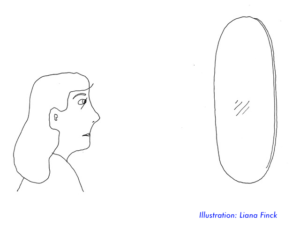
 It was so much simpler when it was just me. The original me. I owned all the space and language that made up my identity.
But now it feels like all the other interpretations of me — consumer, customer, voter, member — are crowding into my personal space. Someone else’s definition of me. As I try to get comfortable with all the labels, usernames, menu options, ever faker versions of reality, I can’t help feeling squeezed. Like the “real” me is slowly, incrementally, inexorably, just disappearing.
I’m not the only one. I see it all the time on the TV news now, a source introduced as ‘X,’ not her real name, not even his or their first name. Blurred faces, distorted voices are popping up everywhere. Fear of retaliation for speaking out against one half of the country is disappearing the other. Nobody wants SWAT teams at their door, men waving guns at their kids, lies about them spread all over Facebook.
Of course, the disappearing goes much deeper than just the news. Online, at the bank, applying for Medicare, my identity is blurred behind a username or sunflower icon or hidden in an account that soon becomes inaccessible because I’ve forgotten some password or failed to find my two-factor verification code.
Code, a word summarizing meaning, is another culprit. Like all the labels suddenly pasted on me during the 2024 election: coastal elite, blue voter, woke, AWFL (pronounced ‘awful’). And all the labels given to other Americans to make me feel different from them, to strip away our common history. Are all of us even on the same main menu? I want to press 11 for more options.
The pandemic didn’t help. The virus made us all disappear behind our front doors, working and shopping all from the same rooms.
But on Amazon, there is no shopgirl suggesting the blue might look better on me than the pink, no man behind the counter at the corner store who knows my husband always buys the paper New York Times on Sunday and often saves it for him or me (even though my husband is a different race than me, even though we only come into the store once or twice a week, and never together). I am happy to pay this man $2 for a Mars bar because I’m paying it to a living breathing person whose face I know, who works in my neighborhood, not some icon in North Carolina with something I need next-day delivery.
After the pandemic came the angry men, who disappeared me all over again.
Erasing “women and girls” from federal directives.
Sidelining “me to” all the way up to the supreme court.
Insisting on barefoot and pregnant, housemaid and eye-candy.
Our sisters in other states denied abortions.
Our sisters in other countries denied education.
Our unique skills as peacemakers, collaborators, multi-taskers, big-picture thinkers drowned out in the din of mansplaining.
All of us disappeared back to the time when boys drooled and girls weren’t allowed to rule.
Here I must acknowledge my predecessors among the “disappeared,” the Irish lost in the “Troubles,” the Central and South Americans snatched by dictators or gangs or military colonels and never seen again.
And I must acknowledge the even earlier disappeared in my own country, the slaves slaughtered for trying to unshackle themselves, the indigenous people that cared for our purple mountains and enameled plains until colonists disappeared them with their diseases and religions and boarding schools.
And I must acknowledge today’s disappeared, whisked away from growing our food and plucking our chickens and caring for our country in so many ways by ICE. And the future disappeared, the people starved in the global south by heat, drought, and wars, and ourselves, the gas guzzlers of the north. We are all now destined to disappear off the face of the earth too, if we chose to continue to foul, rather than clean, our own nest.
It’s easy to blame the obvious for our disappearance. Clearly louder, more influential, more greedy people are deciding our future for us, and repeating their vision like zombies on the insidious, unregulated, highly profitable internet. Our doom written right there in a tweet amid the dogfood ads and Doge hit lists. Our buying habits and labels now so much more valuable than our humanity.
We can’t hide under our hoodies and masks and inside our black mirrors and behind our locked front doors with Ring cameras forever. If we don’t come out and look people in the eye, shake their hands, remark on their beautiful children, inquire about which peaches in which basket taste best today, we are lost.
The tragedy is it’s not that hard to reappear. We can unclick our global selves and reinhabit our local selves. We can speak truth to power, confront the bullies. We can boycott and regulate social media and ai and oil companies. We can give our children dumb rather than smart phones. We can even leave the phone at home when we walk the dog or the baby so we can return the puppy love in their eyes.
We can make room for everyone in our communities, not just the ones with the same labels. We can honor women. We can stay the course on the clean energy economy. We can offer refuge to the oppressed, starving, and frightened. We can fight for truth and equality.
Or we can just binge-watch another Netflix series.
Whatever way you disappear, somewhere along the way there’s a choice.
Ariel Rubissow Okamoto is an environmental writer, book author, and the editor of a climate resilience magazine in California.